 Dec 17, 2025 6 mins read
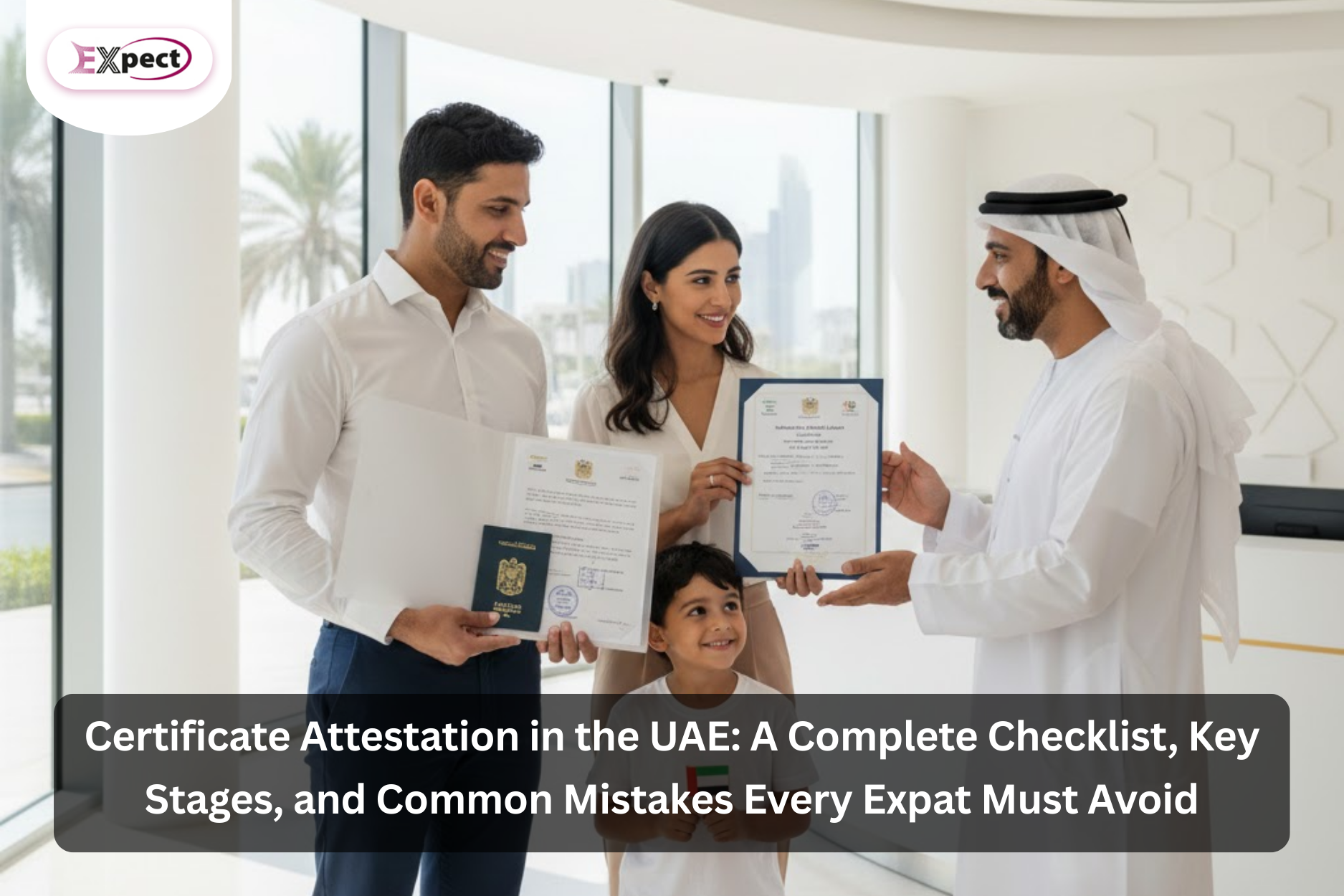
Certificate attestation in the UAE is far more than an administrative requirement—it is the legal gateway that allows expatriates to live, work, study, and settle in the country without obstacles. Every year, thousands of professionals, students, entrepreneurs, and families relocate to the UAE, only to realize that their foreign-issued documents hold no legal value unless properly attested. Attestation is the official process through which UAE authorities confirm that a certificate issued abroad is genuine, issued by a recognized institution, and verified by the appropriate government bodies. Without attestation, even authentic degrees, marriage certificates, or birth records are considered invalid. This makes attestation one of the most critical steps in an expat’s UAE journey, forming the foundation for residency visas, employment approvals, university admissions, professional licensing, and dependent sponsorship.
The UAE operates under a strict regulatory framework designed to protect its institutions from fraud and misrepresentation. Certificate attestation plays a key role in maintaining this integrity. For residency purposes, attested documents validate an individual’s identity, marital status, and family relationships. In employment scenarios, attestation confirms that a candidate’s qualifications meet UAE standards, which is especially important in regulated professions such as healthcare, engineering, education, and finance. For students, attestation verifies academic history and institutional accreditation, ensuring that universities admit only qualified candidates. In all cases, attestation acts as a legal bridge between the expat’s home country and the UAE, allowing foreign documents to be trusted and accepted by local authorities.
Documents requiring attestation generally fall into three broad categories: educational, personal, and commercial. Educational documents include degrees, diplomas, transcripts, mark sheets, and school certificates, which are commonly required for employment and higher education. Personal documents include marriage certificates, birth certificates, divorce decrees, and death certificates, which are essential for family sponsorship and legal matters. Commercial documents include powers of attorney, company incorporation papers, contracts, and business agreements, often required for entrepreneurs and investors. While the overall attestation structure remains similar, each document type may involve specific authorities or additional verification steps, making it essential to understand requirements in advance.
Certificate attestation follows a strict, multi-stage process that must be completed in sequence. The process begins in the country where the document was issued and ends in the UAE. The first stage involves verification by the issuing institution, such as a university, school, or registrar. This confirms the document’s authenticity at the source level. The second stage is notary public attestation, which authenticates signatures and seals. The third stage involves attestation by the relevant government ministry in the home country, such as the Ministry of Education or Ministry of External Affairs. The fourth stage is attestation by the UAE Embassy or Consulate in the issuing country, confirming UAE recognition. The final stage is attestation by the UAE Ministry of Foreign Affairs and International Cooperation, which legally validates the document for use across all emirates.
One of the most misunderstood aspects of certificate attestation is the importance of sequence. UAE authorities require documents to pass through each stage in a specific order, and any deviation results in rejection. Skipping notary attestation, missing home-country ministry verification, or attempting UAE MOFA attestation without embassy approval renders the document invalid. Authorities do not accept partially attested certificates under any circumstances. This strict sequencing exists to ensure a clear chain of verification, where each authority confirms the authenticity of the previous endorsement. Understanding and respecting this order is essential to avoiding delays, rejections, and costly reprocessing.
Despite its importance, certificate attestation is often mishandled due to lack of awareness. One common mistake is submitting laminated certificates, which are frequently rejected because seals and signatures cannot be verified. Another frequent error is using provisional certificates or photocopies instead of original or officially reissued documents. Name mismatches between passports and certificates—such as spelling variations or missing initials—are another major cause of rejection. Many expats also make the mistake of starting the process too late, assuming attestation can be completed quickly. Others rely on unverified agents, risking document loss or incorrect processing. These mistakes can turn a straightforward process into a stressful and expensive ordeal.
Errors in certificate attestation can have serious real-life consequences. A single missing stamp or incorrect sequence can lead to visa rejection, job offer cancellation, or university admission loss. Family sponsorship applications may be delayed for months due to improperly attested marriage or birth certificates, causing emotional and financial strain. In professional sectors, failure to submit attested qualifications can prevent license approvals, halting careers entirely. These outcomes highlight why attestation should never be treated as a last-minute task or a minor formality. Accuracy, preparation, and compliance are essential to protecting one’s plans and opportunities in the UAE.
The time required for certificate attestation varies depending on the country of origin, document type, embassy workload, and verification complexity. While some documents may be completed within a few days, others can take several weeks. Costs include government fees, embassy charges, courier expenses, and professional service fees if assistance is used. Attempting to save money by skipping steps often results in higher costs due to rejection and reprocessing. Proper planning—starting early, budgeting realistically, and understanding timelines—helps expats avoid unnecessary stress and financial loss.
For many expats, navigating multiple authorities across different countries can be overwhelming. Professional attestation services simplify the process by managing document verification, sequencing, translations, embassy coordination, and UAE MOFA submissions. These services reduce the risk of errors, save time, and provide peace of mind, especially for first-time applicants or those with urgent deadlines. A reliable service provider ensures that documents are handled securely, processed correctly, and delivered on time, minimizing disruptions to relocation plans.
Certificate attestation is the backbone of legal life in the UAE for expatriates. It enables access to employment, education, residency, and family stability while ensuring compliance with UAE regulations. By understanding the attestation stages, following the correct sequence, avoiding common mistakes, and planning well in advance, expats can navigate the process smoothly. Whether handled independently or with professional support, a well-executed attestation strategy ensures that documents are legally recognized and that life in the UAE begins on a solid, secure foundation.


 +971 50 6369784
 Nov 15, 2022